Sunday, 1 April 2018

Tipton Church altar

Tipton St John Church Altar.
The chancel of Tipton St John Church is maybe not somewhere you have looked closely but a friend from America asked me to take a photograph of the reredos behind the altar. He was interested in two small discreet carved figures on either side of the altar table.  On the left is King Henry, founder of Eton college and on the right St Charles the martyr. I had never noticed these figures before. On looking closer I found that the reredos and altar was given by Dr Henry Ley  (precentor of Eton College) and his wife, Evelyn, in memory of her father Rev Heurtley and grandfather, MA Fellow of Corpus Christi College and the Ley family. The family has a very high church background and great lovers and writers of music.
Dr Henry and Evelyn Ley lived at Coombewater Cottage and were active members of the church and supporters of the school at Tipton, often taking part in the end of year prizegiving of books and bibles.  Mrs Ley wrote a hymn "The church on the hill" for the centenary of Tipton church in 1940.  When she died in 1946  the schoolchildren lined her graveside wth spring flowers. Dr Henry Ley, Professor of organ at Royal College of Music, London and Precentor at Eton, would play the organ at Tipton St John Church. He played recitals often in cathedrals all over the country and played at no less than 3 Coronations. Our organ must have seemed very small in comparison! The organ was originally upstairs at the back of the church, later it was moved to its present position to the right of the altar. The photograph shows just how dramatic the balcony looked back then with the organ under the Rose window.
When the church was first built in 1840 there was a "rich and chaste altar screen, divided into four compartments by triple columns with carved arches."  (see photo) The walls were painted with twining plants and writings from the bible, even the ceiling was decorated.  I would love to have seen the church with these amazing decorative paintings. The very beautiful antique altar table is in wood, being reduced from a screen in, none other than Cologne Cathedral, given by the Rev. George Coleridge of Ottery St Mary church.
The Leys had the new altar designed in 1938 by Herbert Read of Exeter. The figures represent (from left to right) St John (Tipton St John) St Peter (Exeter Cathedral) St Mary (Ottery St Mary) Christ is the central figure, robed as King of the earth  then St Therese (Dr Ley's sister)  St Benedict (Dr Ley's brother's name as a monk - Dom Benedict) and St Micheal (Chagford church  - Dr Ley's father was the vicar here).
Thank you Dr and Mrs Ley for a beautiful family and religious memorial in our church.
Had I not been asked to take that photograph I may never have noticed the beauty and history behind our altar!
"In piam memoriam"   Charles Able Heurtley, Priest and Mary Elizabeth his wife.  "Requiescant in face"

Thanks to Marilyn Berry and Chris Baxter for the old church photograph, Rev. Mark Ward and Clinton Crawshaw for the inspiration.
The Newspaper Archives. Exeter and Plymouth Gazette.

Thursday, 1 February 2018

The water pump.

The village water pump
During a cup of tea, my sister happened to remark that whilst walking the dog they had come across the base of a water pump, near the mill stream track, next to Willow Tree Cottage (was Dolphin Cottage). Jane and Mark have a similar pump and recognised the base. I have walked past this metal base hundreds of times but never realised what it was....until now. The actual pump and handle are unfortunately long gone but it got me thinking....
       .....when was the pump in use, who would have used it and when was running mains water introduced to the village?
Most of the the old houses and cottages were built alongside the brooks that ran down from East and West Hill so that they could use the constant supply of water. Over the years though pollution from grazing animals, farming and  sewage made the water taken from the streams and brooks dangerous to drink. Some properties were lucky enough to have their own well,  Elmgrove House,  Hayne and Mallocks had a well in the garden, and I imagine many other houses and farmhouses had one too.  Most of the cottages though were not so lucky, so they had to go to the pump for their water.
It was reported that the only public water pump was at Mr Potters, the blacksmith, ( The Old Smithy) which was only available up until 6pm, then it would be padlocked whilst the smithy was closed. Mr Potter would also service and repair the pump. The Urban District Council paid him £2, increased to £4 for this service in 1913. The pump supplied at least 9 cottage tenants. This arrangement continued until 1924 when a new well with a good supply of fresh water was found and the new community water pump at Dolphin Cottage was installed in 1925.
There was much gossip and suspicion in the village about the quality of  the water in the new well, so the council  " ever desirous of doing the right thing", sent a man out to collect a sample to be analysed.
The Council were told "the sample was of excellent purity, good for drinking and of satisfactory quality for domestic use" and so the chairman remarked  "That's that"!

The pump would go on to be used for many years.

The household sewage would be buried in the garden or more often thrown in the brook or river. The mill would release water once a week, to increase the water flow, so everyone used to empty their waste, which would then get flushed quickly away into the river. 

At many Ottery Council meetings the lack of help for the village was often brought up by local rate paying residents and a report was written in 1913.

    "Conditions were a menace to the health of the village and an epidemic of contagious disease was imminent"

      "It appears that provision has been made for the removable of the closet deposits to be collected only twice a week by means of a cart"!  

Tipton wasn't connected with water and sewage mains until the l950s, as the new houses were built, with some more 'out of the way' properties still relying on a well and pump until the 1970s

We just take it for granted, to turn on on a tap or flush the toilet, but within living memory it was a case of walking with your bucket to the pump and 'fetch your pail of water'  before you could even start the washing up!

Well, well, well....next time you are out walking, see if you can find what's left of the village pump.

Acknowledgements to Len Baker, Marilyn Berry, Chris Baxter, Ann Knight, Jane Hembury, Mark Taylor, British Newspaper Archives.

Friday, 1 December 2017

How times have changed

                                       How times have changed

I spend quite alot of time looking through census information when I  am investigating the houses and people of Tipton past and when looking at the occupations of villagers you can see just how things have changed over the last 150 years. Tipton was mainly based around farming in the 1800s, with its fertile soils and supply of water from the Otter and it's tributaries. So there's no surprise that most of the households were farm related and then later the Railway brought new employment and opportunities.  The main farmhouses of Hayne, Coombe, Woods, Metcombe, Fluxton etc where the  biggest landowners, the farmers  lived, would need a good supply of domestic servants and farm labourers. These workers would usually live in the cottages around the farms, sometimes the cottage would come with the job. The farms would provide meat, wool, eggs,vegetables, milk and other dairy products for the local area. Mallocks House kept a well established orchard for many years supplying fruit.
The village had Blacksmiths to keep the horses of the village shod and to work on making or mending metalwork. The Old Smithy area is often referred to as 'Potters corner' as this was the surname of one of the families of Blacksmiths that lived and worked there. The waggoners and wheelwrights were also important for keeping the carts and wheels rolling!
The Mill has been important in the village for many years (and still is although the system is obviously different these days). When the original riverside mill was rolling it would have been only grinding corn and flour where as now the mill provides us with all sorts of animal feeds. Miller and Lilley came with the growth of the railway selling building supplies, coal and animal feeds.  The Golden Lion Inn was not just a place for refreshment, but travellers could stay overnight and stable their horses, so there would be people to serve the ale and tend to the horses. There were several shops too, Dolphin Cottage (that was) was Tipton general stores and a dressmaker, lacemaker, shoemaker/mender were all living along the Railway terrace. We had not only the Post Office, but also our own postman who delivered mail and information around the village. There were also many Market gardeners in the valley providing us with salads,  vegetables, and flowers. Goods would be sold from their house or sent off by horse and cart or train to local towns, even up to London. Mr Eli Baker grew flowers and soft fruits at Coombe and his name crops up often in newspaper reports for his displays of prize cut flowers in shows and at weddings. Mr Berry grew anemone and lily of the valley amongst other flowers that would be packed and sent to Covent Garden market. Liz Rodgers remembers packing up  daffodils at her father, Mr Bartletts nursery and her mother would make up polyanthus posies. I remember visiting Mr Bartlett at Lancercombe to buy all sorts of salads and vegetables with my mum. The wonderful smell of vine tomatoes takes me right back to his greenhouses and his barn full of  tools, wooden boxes and my favourite, the ships bell that hung on the wall which I was allowed to ring if I was good ( I was very happy to find out recently that Liz still has the bell ).
The presence of the village school meant that several school teachers have lived in the village over the years, with many people remembering Miss Richardson. The church had its own vicar living in the vicarage who employed house servants and the church sexton. We had a sawmills, timber men, thatchers, stonemasons and carpenters.  Sam Pottinger was a chimney sweep and provided logs. Later came Tipton Garage (still going strong), Rutherfords builders, and the Angela Hospital all needing skilled workers.
It was almost as if Tipton could have been self sufficent
Do you think that the same could be said today? Well certainly some of these jobs and business have  continued and some flourished.  New opportunties have brought different occupations into the village and of course more people work outside of the village now. Sadly though many of the rural skills once common place  have become redundant.
Maybe you could say that the people of Tipton St Johns occupations have had to diversify over the years and change with the times!
                            " Times change and we change with them"
Credits to Len Baker, Ann Knight, Liz Rodgers, Marilyn Berry, Ancestry and The British Newspaper Archives

Wednesday, 4 October 2017

5th Oct 1917

Remembering 100 years ago.
Harry (Wheaton) Channon was born in 1893 to parents Emily and Robert Channon. Harrys mother Emily (Wheaton) was born and raised in Venn Ottery along with 10 other siblings. Her mother died when she was only 10 and after finishing school and helping to look after her younger siblings she left home to work as a housemaid for the Rector at Combe Raleigh. Whilst there she fell in love with the local postman and they went on to marry in 1892 . The following year Harry was born but unfortunately his father Robert died and Emily was left to bring up Harry alone. She quickly returned to Venn Ottery and took on lacemaking work to bring in some money. Harry attended Tipton st John School and when he was old enough he went to work as a farm labourer. As WW1 loomed Harry signed up to the 8th Battalion of the Devon Yeomanry and left Tipton and his mother Emily far behind when he was sent to war. Sadly on the 5th October 1917 at just 24 years of age Harry was killed in battle in France. A battle fought in atrocious conditions exasperated by bad weather conditions. He is buried at Zonnebeke.
After the war, in 1923 a marble memorial was mounted on the wall in Tipton st John Church dedicated to Harry Channon, along with William Pottinger (Metcombe) Thomas Pratt (Coombe), Samuel Bennet,(Tipton Lodge)  William James (Metcombe) and  Donald Bastin (Tipton) who all gave their lives during the Great War. At the service the church was so crowded that every seat was taken long before the service began, the gallery was packed and people stood on the stairs. The Rev Every took the service and began with the hymn 'Soldiers of Christ Arise'. Sir John Kennaway on behalf of 195 subscribers unveiled the memorial and 'the mournful notes of the last post rang out with remarkable clearness' from the church, across the valley .  'A verse of the National Anthem concluded the service which will never be forgotten by those privileged to be present'

So on the 5th of October maybe say a little prayer for Harry,  for his life that he bravely gave for his country and also for Emily, his mother, who lost her beloved son 100 years ago.

At the going down of the sun, and in the morning, we will remember them.

Friday, 4 August 2017

Tipton St John School log books

Whortleberry picking and haymaking .
Ann Knight and myself have been lucky enough to view the school log books of Tipton St John Church of England School..
Teachers would carefully note down term dates, attendances, curriculum and other interesting snippets of the past school life.
During WW1 many children would be absent from school during the summer months as they would be helping with chores such as haymaking and planting potatoes. Whortleberry and blackberry picking are also often referred to as reasons for absences. It was often noted that the infant classes were well attended whereas the older children were found to be kept home to work or to help on the farms.
During WW2  the children were often reported to be helping to raise money for the war efforts, with concerts and sales.  They would grow vegetables and flowers in the school garden which were regularly collected and given to The Angela Childrens home, along with eggs brought in from home by the children. Sometimes the whole school would go out for the afternoon blackberry picking. Evacuees were welcomed into the school with 18 registered at one time, including Ronald Edwards (Buster Edwards, of 'the great train robbery'!) who was living with his sister Renne under the care of Mrs Chown, at Lower Court, Fluxton. Air raid practises took place regularly and safety checks were made to the childrens gas masks by members of the Home guards. 
During the 1940s the children sent a letter to Enid Blyton, telling her about a blackbird that during the Easter holidays, had built its nest in one of the easels which stood at the back of the school. The nest was made of moss, dried grass, ivy and had a mud lining. She wrote in the 'Teachers World' thanking the children for the letter, paintings and flowers they had sent her, and said " I do think some schools are lucky, the way wild birds nest in them, don't you? "
Illness has always been rife amongst schoolchildren and Tipton was no exception with whooping cough, ringworm, influenza, chicken pox, scarlet fever, diptheria, scabies, lice and measles invariably cropping up all too often in the register, the medical officer closed the school on several occasions due to measles . In 1899 it was reported that the incessant coughing in the infant class was so bad that it was practically impossible to work, and some children were sent home.  Sometimes families were asked to keep their ill children and siblings at home for periods of time. Sadly there are also a few deaths marked on the register
It was often noted that the heating was either insufficient or not working at all and sometimes there was no water due to the hard frosts. Water would then have to be collected in pails and kettles from the Institute and walked up to the top school. Flooding was obviously a problem back then too as the school would sometimes be closed for this reason.
In 1899 children walked to Newton Poppleford to witness the opening of the train station and sadly in 1967 thay were 'marched' to Tipton Station to watch the last train leave our village and a ticket was attached in the notes.

What an honour it has been to read the school notes and to remember how lucky we are to have a school with such a history.
Although the main ethos of this church school has remained consistent over the years, events have changed the day to day running at times, but the teachers and children would adapt and work with what they had and also support the community and their families. We still see this community in the school today, but prehaps less of the whortleberry picking and haymaking!

There will be more about the school and other Tipton memories in Ann Knights book 'Past and Present',  which will be coming out next year.

Venn Ottery Flower Festival

Venn Ottery Flower Festival.
In the midst of one of the hottest weeks of the year we embarked on the task of setting up for the festival. It was just about bearable in the cool shade of the church, and people arrived to help set up displays, dust the cobwebs and sweep the ailses.  Then the refreshment tent was set up in the beautiful garden of Patricia Avery at Minors, what a fantastic host she was, Thank you Trish. Cakes arrived and the amazing Paul and Stephanie Kinson appeared and set up the refreshments, sorting out all the extras that I  had overlooked and more, you both were a great support. Mum had made lists of people to steward the chuch and arranged for tea makers who all dutifully turned up for their shifts!
...and then the Flower Festival began.
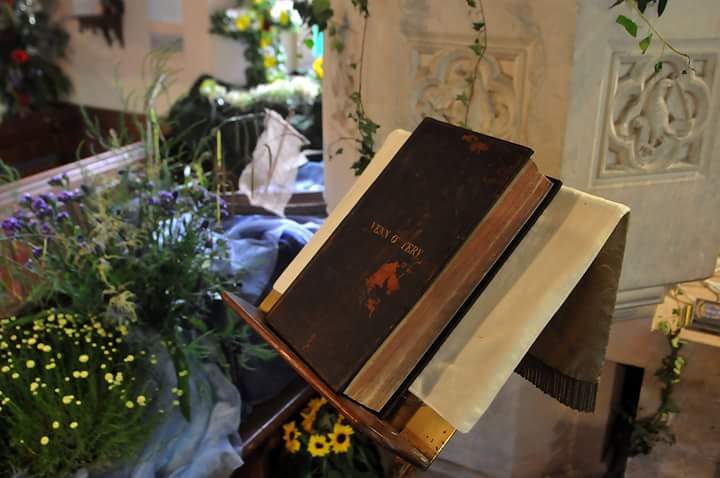
We opened up the side door of the church giving a rare view of the tower and through the main building to the altar. It also gave a much appreciated cool breeze through the church. Not only did we have beautiful flower displays based on hymns, but old maps, documents, photographs  and newspaper reports of Venn Ottery. The Bible and Prayer book that have recently returned to the church were also on display along with a stained glass window dedicated to the Furneaux family who were given the Manor of Venn Ottery, by the King, not long after the Battle of Hastings.
We ended the week with a Songs of Praise service, with all the doors open and the sound of the blackbirds in the chuchyard
Thank you so much to everyone who took part in the flower festival and all those who came to visit, some visiting Venn Ottery for the first time.
Thanks to everyones effort (and perspiration!) not only did the church look beautiful, we all raised over £600.

Friday, 2 June 2017

Augustus montague Toplady

Augustus Montague Toplady

                   In Venn Ottery we have many things to celebrate!
We have just had our Venn Ottery bible and prayer books restored and returned to the church, this year we also celebrate 250 years since Rev Augustus Montague Toplady was our vicar and we give thanks for the life of  our local boy Harry Wheaton Channon, who died 100 years ago, in WW1.
In June we will be holding a Flower Festival to celebrate these and other interesting moments in Venn Otterys history.
The Rev Toplady, born in Surrey in 1740 was an Anglican cleric, preacher, poet and hymn writer. He is probably most famous for writing 'Rock of Ages'. He was brought up by his mother after his father died , and was ordained as an Anglican priest in 1762. Not long after he went to Somerset and then to the parishes of Harpford and Venn Ottery
Augustus Montague Toplady was instituted as vicar of Harpford, and Rector of Fenn Ottery, as it was then known, on 6th May 1766 when he was a youthful looking bachelor clergyman, only 25 years old. 
Although he was provided with a vicarge in Harpford he chose to lodge in Venn Ottery with  the Salter family who lived at their farmhouse, Minors, close to the church.
He made Venn Ottery his headquarters and sallied forth from there to Harpford, holding morning and evening services at both churches alternately. His services would usually be prayers and preaching, he would generally preach for 40 to 50 minutes.
Funerals would often take place on Sundays and even Christmas day, meaning sextons, bearers and undertakers would have to work on the Sabbath.
Communion was celebrated only 4 times a year.  The churchwardens' accounts for 1766/67/68 show that the wine for these occasions cost the astonishingly  large sum of 18 shillings. It was known if any consecrated wine was left over that the communicants  and the Priest were called upon to reverently eat and drink up, obviously this was observed literally !
Surplices of those days were larger and longer,  than nowadays, with many elaborate folds, which would have kept the laundress busy.  The entry for the cleaning reads ; "2 s 6d paid for washing of the surplices". 
The accounts show that he would order bushels of wheat for the poor in the cold weather from the local farmers. He did this on several occasions naming the needy of the area - sadly quite a long list.

Whilst living here he wrote a diary detailing his readings, preaching and thoughts, as well as day to day life in the valley.
At Christmas of 1767 he writes : " read prayers and preached and administered Holy sacrament here at Fenn Ottery.  Farmer T ( whom I had met at Metcombe only 2 days previous, so drunk that he could not sit on his horse) presented himself at the Lord's table with the rest of the communicants;  but I  passed him by, not daring to administer the symbols of my saviour's body and blood to one who had lately crucified him afresh and given no proof of repentance,  he appeared surprised and abashed". "Lord make this denial of the outward visibal sign, a means of inward and spiritual grace to his soul" !

In January of 1768  "At Fenn Ottery in the afternoon I read prayers and preached to a very full congregation especially considering the quantities  of snow that lies on the ground and the intenseness at the frost which render it almost equally unsafe to walk or ride. I  was surprised to find that I had detained my dear people for 3/4 of an hour and yet when I concluded they seemed unwilling to rise from their seats; not withstanding the unusual  intenseness of the cold."

Another time he writes of a sad tale of William Towning, 19, who was brought before Mr Penney, for breaking into and robbing 30 shillings from farmer Endicott 's house while the family were at church.( Mr Penney lived at Elliotts Farm , (Venn Ottery House) and is quite respected and referred to as constable in the parish documents, so something like the local policeman.) William was to be taken from Penney's to Exeter Jail, when his father arrives, having heard what has happened to his son. The young man, seeing his father, "with a look that too plainly declared the pains of his heart", bursts into tears and along with his father and his guard all take a moment in the Orchard before he is taken away. "Lord if it be consistent with the counsel of thy will, be the comforter and the salvation of this sinner and his afflicted family ".

He describes in his diary, of taking a walk, on the 8th of March 1768, with a friend after lunch, up onto Fenn Ottery  hill, where they could see both towers of his churches. They noticed smoke rising from the village of Harpford, not far from the church. They continued their walk for 3 hours, passing over the Aylesbeare hill and into Metcombe where a farmer asked if they had heard of the fire and as the farmer put it "Sir, your house (Harpford vicarage) is burnt to the ground". After eventually crossing the wooden river bridge to Harpford, he found the vicarage consumed by flames.

During his time at Harpford and Venn Ottery he suffers the symptoms of TB, often mentioning feeling ill and cold. Venn Ottery is often referred to as a damp wet area, so it is easy to imagine that this did not help to improve his health.

During the  Easter of 1768 he suffers with his chest and loses his voice struggling to preach. 
" I  was considerably out of order and experienced something of what it is to have a body without health and a soul without comfort".
Yet a short while later in April 1768 he visits Mr Leigh of Hayne Farm, (Tipton st John ) as he has on other occasions  spending the afternoon in conversation and drinking tea!  "On my way home to Fenn Ottery , especially as I was riding over Tipton bridge,  my soul was in a very comfortable frame"

He left Venn Ottery and Harpford, for Broadhembury, in May of 1768, but returned to  take services to cover for his successor, Rev Luce.
His diary refers to one of his last services at Venn Ottery
" If I might judge from the tears which some shed under the word preached ( and, indeed, I  myself did with great difficulty refrain from weeping,  toward the conclusion), the message of salvation seemed to be attended by power delivering the tidings of peace and salvation to a people of whom I had of lately, the charge and whom I affectionately love in the Lord"
Toplady died in 1778, in London from TB, he was just 38 years old.
The Venn Ottery Church altar window has a dedication to him, erected in 1913.
         Do come along and visit the church and join in the celebrations!